
Meaning, Rules and a Buyer’s Guide for Land Near Pune (2026)
A Sai Sparsh Properties guide · Land near Pune · Mulshi | Paud | Hinjewadi corridor
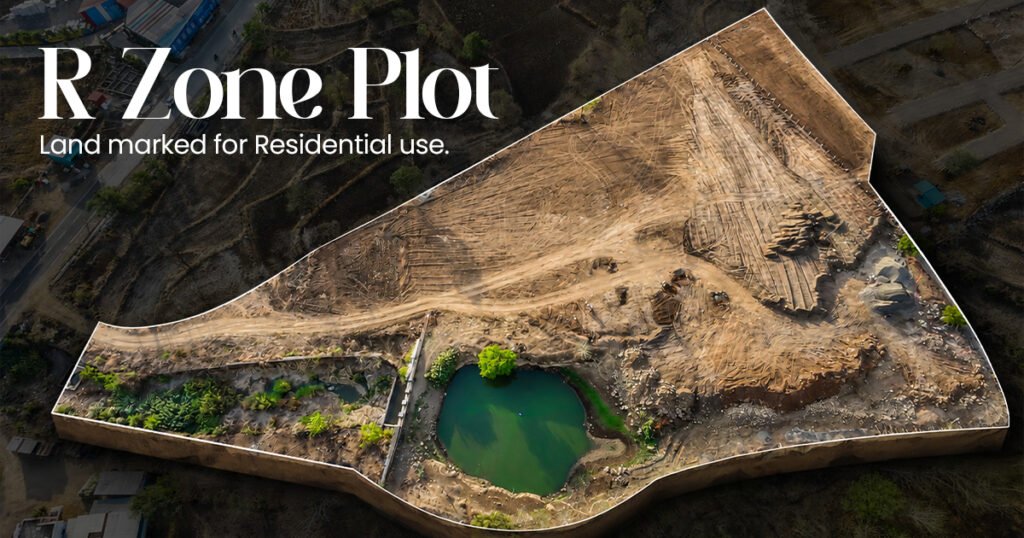
‘R-zone’ is one of the most misunderstood words in the Pune land market. An R-zone plot is land that a development plan has marked as a Residential Zone — the category set aside for homes and housing layouts. It tells you what you are allowed to build, and it is one of the first things to check before buying any plot near Pune.
Zoning sits at the heart of every land decision, yet most first-time buyers only hear about it after they have paid an advance. This guide explains what an R-zone plot is, the rules that govern it in Maharashtra, whether you can build on it, how it differs from an NA plot, and what to verify before you buy in the Mulshi and Paud belt.
What is an R-zone plot? (R-zone meaning in land)
Quick answer: An R-zone plot is land that a city or regional development plan has designated as a Residential Zone. Zoning decides what can be built on a parcel; R-zone is the band reserved for houses and residential layouts. In Maharashtra, R-zone development is governed by the Unified Development Control and Promotion Regulations (UDCPR).
Every planning authority prepares a development plan or regional plan that divides land into zones — residential, commercial, industrial, green or no-development, public and agricultural. Each zone has its own rules about what you can and cannot build. R-zone, short for Residential Zone, is the one earmarked for homes, bungalows and residential plotting schemes.
So when a plot is described as ‘R-zone’, it means the plan permits residential use on that land. That is a strong signal for a home buyer, because a plot in a green or agricultural zone allows very little construction. R-zone status is the difference between a plot you can eventually build a house on and a field you can only farm.
The R-zone meaning in land terms is therefore about permission, not ownership. It answers ‘what is this land meant for?’ rather than ‘who owns it?’ — and it works alongside the plot’s legal NA status, which we come to below.
R-zone plot rules in Maharashtra (UDCPR, FSI and setbacks)
Quick answer: R-zone plot rules in Maharashtra are set by the UDCPR, a single rulebook that standardises residential construction across most of the state. It defines the Floor Space Index (FSI) you can use, the margins and setbacks you must leave around the building, height limits, and the minimum road width your plot must front.
Under the UDCPR, an R-zone plot comes with a defined FSI — the ratio that controls how much built-up area you can put on the land — along with side and front margins, permissible height, and access-road requirements. These rules decide the real buildable value of a plot, which is why two R-zone plots of the same size can support very different homes.
For a plotted layout, the developer must also get the layout sanctioned and leave land for internal roads and open space. When you buy inside a sanctioned R-zone layout, much of this groundwork is already done, which is one reason approved gated plots command a premium over loose survey-number land.
Rules do change and vary by location, so the FSI or margin that applies to a plot in Mulshi may differ from one closer to the city. This is exactly the kind of detail a local land consultant confirms before you commit.
Can you build on R-zone land?
Quick answer: Yes — you can build on R-zone land, but only after two boxes are ticked: the land must be converted to non-agricultural (NA) use, and you must obtain the building and layout approvals required under the UDCPR. R-zone status alone permits residential use; NA status makes construction legal.
‘Can we build on R-zone land?’ is one of the most common questions buyers ask, and the confusion is understandable. Zoning and NA status are two separate approvals that must both be in place. R-zone tells you the plan allows a house here; the NA order confirms the land has been legally released from agricultural use so you can actually construct.
You will also come across ‘proposed R-zone’ plots — land expected to be brought into the residential zone in a draft or upcoming plan. These can be cheaper precisely because the reclassification is not yet final, and that carries some risk. A proposed R-zone plot can be a genuine opportunity or a long wait, depending on how firm the proposal is, so verify its status carefully before treating it as buildable.
R-zone plot vs NA plot — what’s the difference?
Quick answer: An R-zone plot is about zoning — whether the plan earmarks the land for homes. An NA plot is about legal status — whether the land has been converted from agricultural to non-agricultural use. A ready-to-build plot near Pune is usually both R-zone and NA-converted; you want to confirm both, not one.
Think of it as two different questions. Zoning asks ‘what is this land meant for?’ and NA status asks ‘is it legally cleared to build on?’. R-zone answers the first, NA answers the second. A plot can be R-zone but still agricultural on paper, which means construction is not yet legal; equally, land can be NA-converted but sit in a zone that limits what you can build. The cleanest residential plots satisfy both at once, which is what makes them worth their price.
Documents to check before buying an R-zone plot
Quick answer: Before buying an R-zone plot near Pune, verify the zoning certificate, the 7/12 extract, the NA order, the title chain, and the MahaRERA and PMRDA approvals. The zoning certificate confirms the land is genuinely in a residential zone; the rest confirms clear title and legal buildability. Independent document verification is the single best protection for a buyer.
Zoning is only one layer. Run this checklist on any R-zone plot before you pay an advance:
- Zoning / R-zone certificate — confirms the plot lies in a residential zone, not a green or reserved belt.
- 7/12 extract (Satbara utara) — shows the owner, the survey number and any charges on the land.
- NA order — confirms the land is legally non-agricultural and buildable.
- Title search — traces ownership through the chain of sale deeds.
- MahaRERA registration — check the RERA number and sanctioned layout for any registered scheme.
- PMRDA / layout sanction — confirms internal roads and plot boundaries are approved.
- Mutation (ferfar) entries — confirm past ownership changes were properly recorded.
If terms like ferfar and Satbara feel unfamiliar, that is normal — reading these documents correctly is where an experienced land consultant in Pune earns their fee.
R-zone plots in Mulshi and Paud (and the 1-guntha entry point)
The Mulshi and Paud corridor west of Pune has become a focus for buyers looking at R-zone plots, thanks to its greenery, growing connectivity and defined residential pockets. R-zone plots here appeal to two kinds of buyers: families who want to build a home in a calmer setting, and long-term holders who value zoning clarity.
Plot sizes are quoted in gunthas — one guntha is roughly 1,089 square feet, and forty gunthas make an acre. A 1-guntha R-zone plot is a realistic entry point for owning a clearly-zoned piece of land near Pune without a large outlay. Whether an R-zone plot is a sound long-term hold depends on its location, approach roads, approvals and how long you keep it — zoning clarity helps, but no plot guarantees appreciation. Buy on verified paperwork first, and treat any future upside as a bonus.
Conclusion
An R-zone plot is, at its simplest, land the plan has set aside for homes — but that single fact sits alongside NA status, UDCPR rules and clean title, and all of them matter. Understand zoning and you can read any Pune land listing with a clearer eye, and avoid the plots where the promise and the paperwork do not line up.
This is where Sai Sparsh Properties works. For close to two decades we have helped families and NRI buyers own clear-title R-zone and NA plots across the Mulshi, Paud and Hinjewadi corridor — including gated, MahaRERA-registered and PMRDA-approved projects (MahaRERA No. P52100077528). Every plot is backed by the same document verification we would run for our own family.
If you are considering an R-zone plot to build on or to hold, talk to the Sai Sparsh team and book a site visit in Mulshi or Paud. Bring your questions about zoning, NA orders and 7/12 extracts — those are our favourite conversations.
📞 Call / WhatsApp: [+91 8975669373] 🌐 Website: [https://saisparsh.co.in/]
Frequently Asked Questions
What is an R-zone plot?
An R-zone plot is land marked as a Residential Zone in a development or regional plan, meaning the plan permits homes and residential layouts there. It sets what you can build; it works alongside NA status, which makes construction legal.
Can we build a house on R-zone land near Pune?
Yes, once the plot is NA-converted and you have the layout and building approvals required under Maharashtra’s UDCPR. R-zone permits residential use; NA status makes building legal. Both must be in place.
What is the difference between R-zone and NA plots?
R-zone is a zoning category (the land is earmarked for homes). NA is a legal status (the land is converted from agricultural to non-agricultural use). A buildable plot is usually both.
What is a proposed R-zone plot?
It is land expected to move into the residential zone in a draft or upcoming plan, but not yet finalised. Proposed R-zone plots can be cheaper because that reclassification still carries some risk; verify the status before treating it as buildable.
What documents should I check before buying an R-zone plot?
The zoning/R-zone certificate, 7/12 extract, NA order, title chain, MahaRERA registration and PMRDA layout sanction, plus mutation (ferfar) entries. Independent property document verification before paying any advance is the best protection.